Friday, July 31, 2009

Venezuela: The End of Freedom of Speech

The Venezuela Congress is preparing a new law (Proyecto de Ley Especial contra Delitos Mediáticos in Spanish, Project of Law Against Media Crimes in English) to end with freedom of speech in Venezuela. Some days ago, the Chief Prosecutor of Venezuela presented to the Congress her thoughts on the project that is already available to the public. The object of the law is crystal clear: criminalize a variety of conducts (acts and omissions) committed throughout the media, all with the sole purpose of hampering that Venezuelans and the rest of the World have access to information about the severe situation of democracy, human rights, poverty, security, and a variety of other issues going on in the country.

However, according to the project itself the reason behind the law is to achieve a balance and harmony between the rights of freedom of expression and the right to have access to appropriate, truthful and impartial information, all of the above in compliance with Venezuela's Constitution, its laws and the treaties and international agreements subscribed and ratified by the State.

What is beyond any kind of imagination is how come this law is in accordance with Venezuela's Constitution and even further, how the law is not going to challenge the obligations Venezuela has acquired by subscribing and ratifying a multiplicity of international agreements.


First, because the Constitution of the Bolivarian Republic of Venezuela guarantees freedom of expression without any possible sort of censorship. This is established on Article 57 and Article 58, which specifically establishes that every person has the right to appropriate, truthful and impartial information, without censorship. The Constitutional Chamber of the Supreme Court of Venezuela has interpreted this provision, clearly ascertaining that the right of freedom of expression is established to the benefit of the citizens and as such, the right is and should be unrestricted and that the broadcasting of information cannot be censured previously. (Judgement No. 1013, June 12, 2001).

The first provision of this Project of Law Against Media Crimes that is worth revising is Article 4, which defines what should be considered a media crime in Venezuela, paradoxically instituting that it will be a media crime any kind of information that generates a sense of insecurity or impunity. It seems obvious that the government is trying to stop the media from broadcasting news about the prevailing insecurity in Caracas and other cities of the country, especially when you take into account that more people die on a weekend in Caracas, than in the Iraq war. During the ten years of the Bolivarian revolution, little has been done to stop assaults, robberies, kidnappings and numerous murders. President Chávez’s talking has increased the hatred between the rich and the poor ones, prompting this situation, so for him and his interests it is better that Venezuelans and the international community are not aware of such situation.


Articles 5, 6, 9 and 11 of the Project, not only criminalize the broadcasting of false news, but also when media manipulates news or even intimidate or instigate war, hatred, violence or hostility during their daily transmissions. Undoubtedly, false and manipulated news are never good to watch, but the problem here is who is going to determine when information is false or has been manipulated. The large majority of the district attorneys, administrative authorities and the judiciary are willing to follow Chávez and his allies’ orders. Therefore, if the government considers that the news is false (for example, let's suppose that according to the media the number of deaths in Caracas on a particular weekend is different from the official number) sanctions will easily emerge against media, its executives and even the anchorman who gave away the news. Manipulation of news is such a vague term that anyone can be accused of such crime whenever the government (meaning Chávez and his allies) desires to.

The genuine and most direct effect of this Project of Law Against Media Crimes will be a forward and straight harassment hostile to freedom of expression in Venezuela, with censorship rising against a mixture of information that luckily still nowadays can see its way to the Venezuelan public and to the international community. Moreover, the channels to criticize will be lost, extinguishing the opportunity to show the inefficiency and corruption of Chávez's government.

Besides the unconstitutionality of the Project, already explained above, we must remember that Venezuela is not only a party to the United Nations, but also to the Inter-American System of Human Rights, where freedom of expression is equally protected. According to Article 23 of the Venezuelan Constitution, such human rights treaties “have constitutional hierarchy and they prevail in the internal order, insofar as they contain norms more favourable to the established ones by this Constitution and in the laws of the Republic, and they are of immediate and direct application by the courts and other devices of the different branches of the government”.

The Universal Declaration of Human Rights clearly establishes in Article 19 that “everyone has the right to freedom of opinion and expression; this right includes freedom to hold opinions without interference and to seek, receive and impart information and ideas through any media and regardless of frontiers. Likewise, Article 13 of the American Convention of Human Rights determines that:

Everyone has the right to freedom of thought and expression. This right includes freedom to seek, receive, and impart information and ideas of all kinds, regardless of frontiers, either orally, in writing, in print, in the form of art, or through any other medium of one's choice.

2. The exercise of the right provided for in the foregoing paragraph shall not be subject to prior censorship but shall be subject to subsequent imposition of liability, which shall be expressly established by law to the extent necessary to ensure:

a. Respect for the rights or reputations of others; or

b. The protection of national security, public order, or public health or morals.

3. The right of expression may not be restricted by indirect methods or means, such as the abuse of government or private controls over newsprint, radio broadcasting frequencies, or equipment used in the dissemination of information, or by any other means tending to impede the communication and circulation of ideas and opinions.

4. Notwithstanding the provisions of paragraph 2 above, public entertainments may be subject by law to prior censorship for the sole purpose of regulating access to them for the moral protection of childhood and adolescence.

5. Any propaganda for war and any advocacy of national, racial, or religious hatred that constitute incitements to lawless violence or to any other similar action against any person or group of persons on any grounds including those of race, color, religion, language, or national origin shall be considered as offenses punishable by law.

The Inter-American Court of Human Rights has indicated that those who are under the protection of the Convention must not only have the right and freedom to express, but also the right to look for, to receive and to spread information and ideas of diverse nature. It is for that reason that freedom of expression has an individual and a social aspect. (Ivcher Bronstein. Judgement, February 6, 2001).

Regarding the individual aspect, the Court has said, that freedom of expression does not exhausts in the theoretical recognition of the right to speak or to write, but in addition it understands, inseparably, the right to use any appropriate means to spread information to a vast amount of people. (“La Última Tentación de Cristo”. Judgement, February 5, 2001; Ivcher Bronstein. Judgement, February 6, 2001; Herrera Ulloa. Judgement, August 31, 2004; Palamara Iribarne. Judgement, November 22, 2005).

Concerning the social aspect, the Inter-American Court has noted that freedom of expression is a route to exchange ideas and information among people, and as such, it includes the right to seek information and to communicate to others our own views. Additionally, it implies the right to find out other people opinions. For the common citizen this right has equal importance regarding the awareness of others opinions and the right to disseminate our own opinion. (Ricardo Canese. Judgement, August 31, 2004).

This right has even more importance when we examine the role of the media in a democratic society, since the media are true mechanisms to guarantee freedom of expression, and not vehicles to restrict it, which is why it is essential for the media to collect the most diverse information and views. (Ivcher Bronstein. Judgement, February 6, 2001).

In consequence, the Inter-American Court of Human Rights has understood that the concept of public order demands that within a democratic society, it is mandatory to ensure a vast flow of assorted news, ideas and opinions from different sources, as well as broader access to information. Freedom of expression is included in democracy foundations, and democracy is not conceivable without free debate and dissent. (¨La Colegiación Obligatoria de Periodistas¨. Advisory Opinion OC-5/85, November 13, 1995).

Freedom of speech is so important to democracy that the Court has not hesitated ascertaining the following:

Without effective freedom of speech, materialized in its entirety, democracy vanishes, pluralism and tolerance begin to fade away, the control mechanisms and the complaints of the citizens start to become ineffective and all this situation prompts to the creation of a fertile field for authoritarian systems grow to be rooted in society. (Herrera Ulloa. Judgement, August 31, 2004).

However, the Court has also recognized the possibility to restrict the freedom of speech, but only through a way which should not limit beyond what is strictly necessary and therefore become direct or indirect censorship. (Herrera Ulloa. Judgement, August 31, 2004; Palamara Iribarne. Judgement, November 22, 2005; Ricardo Canese. Judgement, August 31, 2004).


All this case-law or jurisprudence about freedom of expression in international law is very important, though it may feel useless or inapplicable to Venezuela, since its government, unsurprisingly, is not executing the decisions of
the Inter-American Court of Human Rights, and the Constitutional Chamber of the Supreme Court has even exhorted the Executive branch to denounce the American Convention of Human Rights to withdraw the jurisdiction of the Court.

All these details and the Project of Law Against Media Crimes unmistakably show that everyday the Chávez regime is very far away from democracy and there are already enough grounds for the Organization of American States to apply the Inter-American Democratic Charter, specifically Article 20 which states:

In the event of an unconstitutional alteration of the constitutional regime that seriously impairs the democratic order in a member state, any member state or the Secretary General may request the immediate convocation of the Permanent Council to undertake a collective assessment of the situation and to take such decisions as it deems appropriate.

In the mid time, we must remember two things: First, what George Washington said many years ago about freedom of speech:

If the freedom of speech is taken away then dumb and silent we may be led, like sheep to the slaughter”.

Second, Venezuelans must always remember what Article 350 of their Constitution states:

The people of Venezuela, true to their republican tradition and their struggle for independence, peace and freedom, shall disown any regime, legislation or authority that violates democratic values, principles and guarantees or encroaches upon human rights.

Thursday, July 30, 2009

Análisis Legal del Golpe de Estado en Honduras


1.- ¿Golpe de Estado? Lo que pasó en Honduras la madrugada del domingo 28 de junio de 2009 fue el inicio de lo que está siendo una de las crisis institucionales más importantes de América Latina este año. Cabe destacar, que los militares hondureños empezaron actuando correctamente, ya que tenían como base legal una orden judicial para arrestar al Presidente Manuel Zelaya por la presunta comisión de varios delitos.

No obstante, una vez que Zelaya abandona el espacio aéreo de Honduras para dirigirse a Costa Rica, las acciones de los militares no parecen estar dentro del marco de la constitucionalidad hondureña. En primer lugar, porque la orden judicial no facultaba a los militares a sacar del país a Zelaya y en segundo lugar, porque la propia Constitución de Honduras establece en su artículo 102 lo siguiente: "Ningún hondureño podrá ser expatriado ni entregado por las autoridades a un Estado extranjero".

Luego de analizar la conducta de las Fuerzas Armadas de Honduras y su manifiesta inconstitucionalidad, resulta procedente examinar la conducta del Congreso de Honduras, puesto que fue este Poder el que se reunió en la tarde del 28 de junio para aceptar una supuesta renuncia de Zelaya y para posteriormente emitir un decreto destituyéndolo, y así poder nombrar como Presidente interino a Roberto Micheletti.


La supuesta renuncia pareciera carecer de veracidad alguna, ya que el propio Congreso ni siquiera hace referencia a ella en el decreto mediante el cual nombra a Micheletti y destituye a Zelaya, y el propio presidente en el exilio ha desconocido que esa sea su firma. La aparición sorpresiva de dicha renuncia, por demás, ha traido como consecuencia que el propio Departamento de Estado de los Estados Unidos de América desconozca la autenticidad de dicho documento.

La segunda evaluación jurídica que hay que realizar es si efectivamente el Congreso, de conformidad con la Constitución de Honduras, tiene la facultad de destituir a un Presidente democráticamente electo y además previamente expatriarlo. Sin embargo, cabe antes considerar que esta situación en Honduras no se asemeja a los golpes de estado a los que América Latina está acostumbrada, precisamente porque con el golpe no vemos un cambio radical de autoridades y un gran número de destituciones. Al contrario, la gran mayoría de las autoridades hondureñas permanecen en su cargo e incluso han apoyado la medida ejecutada por las fuerzas armadas de ese país.

Los 15 magistrados de la Corte Suprema de Honduras, el Fiscal General de la República, la gran mayoría del Congreso e incluso un gran número de autoridades independientes han aplaudido la expulsión de Zelaya y han reconocido la legitimidad del gobierno de facto. De hecho, el único cambio en el gobierno pareciera ser la salida de Zelaya y de su gabinete ministerial.

Entonces, ¿es o no es un golpe de estado?. Aquellos que creen que lo que pasó en Honduras no fue un golpe de estado traen como argumento principal lo establecido en el artículo 239 de la Carta Magna hondureña (aunque esta base legal no fue citada por el Congreso en el decreto de destitución de Zelaya): "El ciudadano que haya desempeñado la titularidad del Poder Ejecutivo no podrá ser Presidente o Designado. El que quebrante esta disposición o proponga su reforma, así como aquellos que lo apoyen directa o indirectamente, cesarán de inmediato en el desempeño de sus respectivos cargos, y quedarán inhabilitados por diez años para el ejercicio de toda función pública".

Sin embargo, esta disposición constitucional trae consigo un problema fundamental. La misma no establece a qué organismo del Estado le corresponderá determinar cuándo se ha quebrantado dicha norma y por si fuera poco, no establece un debido proceso para que el ciudadano que haya quebrantado dicha disposición se defienda.

Esto nos lleva a la conclusión de que indudablemente estamos ante un golpe de estado de conformidad con el derecho hondureño, puesto que Zelaya fue destituido formalmente por un Congreso que no tiene la facultad, constitucionalmente establecida, de remover a un Presidente, incluso si se dan las circunstancias del artículo 239 constitucional.


2.- El papel de la Carta Democrática Interamericana. La reacción de la comunidad internacional y especialmente de los países miembros de la Organización de Estados Americanos (OEA), ya es suficientemente conocida por todos. La destitución de Zelaya y el nombramiento de Micheletti han sido catalogados como un golpe de estado a lo largo y ancho de todo el continente americano, incluyendo a los Estados Unidos de América y organizaciones internacionales como la Asamblea General de las Naciones Unidas, la Comisión Interamericana de Derechos Humanos y la Asamblea General de la Organización de Estados Americanos. Con base en el artículo 21 de la Carta Democrática Interamericana, la Asamblea General de la OEA catalogó la situación en el país centroamericano como una alteración inconstitucional del orden democrático y suspendió la participación de Honduras en el organismo.

Esta Carta Democrática Interamericana fue adoptada por la Asamblea General de la ONU en el año 2001 y aunque no es un tratado, un gran sector de la doctrina la cataloga como un instrumento que interpreta la Carta de la Organización de Estados Americanos que sí es un tratado entre los países que son miembros de la OEA y que por tanto, contiene una clara eficacia jurídica.


Pero es justamente en el marco de la Carta Democrática Interamericana que surge un problema de derecho internacional, ya que los conflictos que surgen en el derecho interno, en donde hay que incluir la constitucionalidad o inconstitucionalidad de una actuación de un Poder Público, corresponde a las propias autoridades internas de un país determinado. El derecho internacional, por su parte, normalmente, impone sus propias normas autónomas para regular las conductas permisibles de un país.

No obstante, la Carta Democrática exige que cada Estado miembro de la Organización de Estados Americanos, cumpla con su propia Constitución y por ende, surge la obligación internacional del Estado de cumplir con su propia Constitución y una norma que normalmente sería del orden interno de los países, traspasa al ámbito internacional, todo con el objetivo de que exista un fuerza colectiva regional para preservar el orden democrático de la región.

Por consiguiente, y vista la consagración de esta obligación en el orden internacional, en los países miembros de la OEA, ya no depende de las autoridades internas de cada país (entiéndase cualquier organismo judicial) únicamente la determinación de la violación de la constitución, sino que ahora instancias internacionales, otros países de la OEA y especialmente su Asamblea General, tienen la facultad de determinar si un país miembro es coherente con su ordenamiento constitucional. Esto no significa que hay que deshacerse de la opinión de los organismos jurisdiccionales internos a la hora de una determinación de un acto anticonstitucional por parte de un Poder Público, sino que cuando la violación a la Constitución es clara y el efecto que produce antidemocrático, la Carta Democrática Interamericana debe ser puesta en práctica con todas sus consecuencias.


En el caso Hondureño, es claro que estamos ante una violación flagrante de su orden constitucional y que Honduras está incumplimiendo con sus obligaciones internacionales en el marco de la Carta Democrática. Como ya dije anteriormente, el Congreso no cuenta con la facultad para remover al Presidente democráticamente electo sin al menos un procedimiento donde éste tenga derecho a defenderse, y corresponde únicamente a la Corte Suprema de ese país, luego de que el Congreso concediera debida autorización, determinar si definitivamente Zelaya cometió traición y demás delitos al convocar a la consulta. Sin esa determinación previa, no hay destitución que valga.

Los que defienden la constitucionalidad de la destitución de Zelaya hacen referencia a la facultad que tiene el Congreso, de conformidad con el artículo 242 constitucional, de reponer a una Presidente cuya ausencia o incapacidad es permanente o indefinida. Pero la ausencia de Zelaya de Honduras es claramente involutaria y no puede entrar bajo este supuesto.

En todo caso, también argumentan los defensores del régimen de facto, el ya citado artículo 239 constitucional, que contempla que aquél funcionario que proponga abolir la prohibición de reelección indefinida de un Presidente y todos aquellos que lo ayuden, cesarán inmediatamente de sus cargos en las respectivas posiciones. Pero la auto-ejecución de esa disposición constitucional es problemática y confusa, ya que primero habría que ver quién determina si Zelaya efectivamente violó dicha norma y si en efecto lo hizo, ¿cuándo dejó de ser presidente? En todo caso, sigue llamando la atención que el Congreso no se basó en dicho artículo cuando destituyó a Zelaya. Por último, y en clara contravención a la Convención Interamericana sobre Derechos Humanos, Zelaya fue removido sin que se le respetase su derecho al debido proceso.

Al día de hoy los esfuerzos para restituir a Zelaya como Presidente no han sido satisfactorios. Pero a la luz del derecho internacional y de la democracia, lo más correcto es que Zelaya sea restituido como Presidente de Honduras. Es cierto que a muchos no nos puede gustar esta opción por los nexos políticos de Zelaya, pero si exigimos democracia en algunos países, debemos exigirla en todos. Lo demás es hipocresía.

Thursday, May 7, 2009

The Legacy of Justice David H. Souter to the Judges of the World


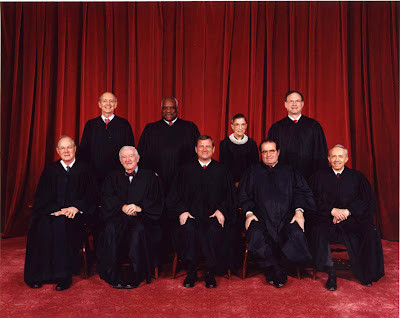
The picture above you will certainly change when the Supreme Court of the United States reconvenes in October after summer recess. Justice David H. Souter is retiring from regular services as a Justice. Souter’s retirement gives President Barack Obama his first opportunity to nominate a Supreme Court Justice and the whole nomination-confirmation process will surely be interesting. However, now is time to look back at Justice Souter’s legacy as a Justice, a bequest that is not only to other judges and lawyers of the United States, but also to the judges of the world.

Born September 17, 1939, Souter became Justice of the U.S. Supreme Court in 1990. He attended Harvard Law School, graduating in 1966. Also disliked private practice and began his career in public service as Assistant Attorney General of New Hampshire in 1968. Souter also occupied the Attorney General of New Hampshire office and grew to be a Justice of the Superior Court of New Hampshire, the New Hampshire Supreme Court and the United States Court of Appeals for the First Circuit.


Former President George H.W. Bush nominated Souter as an Associate Justice of the Supreme Court in 1990, shortly after the United States Senate confirmed him by an astonishing vote of 90-9 after the Senate Judiciary Committee reported out the nomination by a vote of 14-3. However, his story is interesting in the sense that at the time of his appointment, his advisers and the conservatives assured former President George H.W. Bush that Souter would be a home run for conservatism.

Initially, from 1990 to 1993, Souter tended to be a conservative-leaning Justice, but then became one of the most reliable members of the court’s liberal wing, prompting the cry of “no more Souters” by Republican activists, dismayed about how George H.W. Bush’s choice had turned out.


Therefore, and as President Obama said, Souter has shown what it means to be a fair-minded and independent judge. He arrived to the Supreme Court of the United States with no particular ideology and no particular commitment to any political party. That was always clear, since, for example, Souter said during his confirmation hearing that he had no agenda on abortion and that the had not made a decision on how he would vote if the issue of Roe v. Wade was put before him.

Justice Souter is also a gentleman and a scholar who sees no need to show that fact off, and he will go down in history as so. Maybe he can be seen as a misfit or a loner, not quite in touch with modern life. The truth is that Justice Souter is respectful but direct while questioning lawyers who appear before the Court, and such activity displays his scrupulous preparation and his mastery of every case at hand. A Justice has to always make tough decisions and possibly gain some enemies for doing so, but there is nothing more important than a respectful judge, one who complies with the law in order to have the moral authority to instruct others to comply with it.

As any other man in the world, Justice Souter can also be examined by his work. And the main job of a Justice is to write opinions. Nevertheless, there isn’t any landmark case with Justice Souter’s majority opinion signature. What we have from his time in Court are 156 majority opinions and 123 dissenting opinions. Worth mentioning are the following cases:

The most remembered case will surely be Planned Parenthood v. Casey where he developed a joint opinion with Justice Kennedy and former Justice O’Connor that practically upheld Roe v. Wade, a case concerning abortion rights. Souter wrote that Roe v. Wade should not be overturned because it would be “a surrender to political pressure”. Other opinion that will always take us back to Justice Souter is his powerful dissent in Bush v. Gore, the 5-to-4 decision that ended the disputed Florida recount in the 2000 presidential election and effectively declared George W. Bush the winner. Souter demanded that the presidential election recount continued in Florida, a position that was not taken by the majority of the Court.


Legal expert Jeffrey Toobin wrote recently that his favorite Souter opinion came in a largely forgotten case named Bowles v. Russell. In that case, Keith Bowles was sentenced to fifteen years to life for a murder in Ohio. He wanted to file an appeal in federal court. The judge told him he had until February 27, 2004, to submit his papers. Bowles’s lawyer turned them in on February 26th. But the judge had made a mistake. The law said that the deadline should have been February 24th.
Should Bowles be allowed to proceed with his appeal, because he had relied on the judge, or should he be barred under a strict reading of the law?
By a vote of five to four, in an opinion by Justice Clarence Thomas, the Court said: The law’s the law. Bowles missed the deadline, which he might consider as he potentially spends the rest of his life in prison.

Souter wrote the dissent for his three liberal colleagues, and for Toobin, the opinion is a lesson in graceful outrage. “It is intolerable for the judicial system to treat people this way, and there is not even a technical justification for condoning this bait and switch,” Souter wrote, “I respectfully dissent.”

Some might think dissents are not important. However, dissents can be a great opportunity to create philosophical ground upon which citizens can advance alternative interpretations of the constitution of their own. For example, let’s take a look to the dissent of Justice Ruth Bader Ginsburg (actually the only woman in the Court) in the pay equity case of Lilly Ledbetter.

Ginsburg, joined by Souter, in dissenting from the majority opinion, which threw out Ms. Ledbetter’s suit because she did not file it as soon as she received her first short-changed pay check. Yet Ms. Ledbetter, an Alabama grandmother, did not learn of the pay disparity she suffered until someone put an anonymous note in her box. Moreover, as Justice Ginsburg explained, women in all-male work force are often scared to make waves.

Justice Ginsburg forceful and passionate dissent helped frame the issue. Her plain language spurred activists, politicians and even the Obama campaign to push Congress to change the law. As a result of this mobilization, the first major piece of legislation signed by President Obama, the Lilly Ledbetter Equal Pay Act, overruled the Court majority’s restricted decision.


It really doesn’t matter that Justice Souter didn’t get to write the majority opinion of any landmark case. What really matters is that Souter was always there to write clear and respectful dissents, which might actually change the legal panorama someday. This proves that Souter consistently defied labels and rejected absolutes, focusing instead in one task: reaching a just result in the case that was before him.

President Obama also said that Justice Souter approached judging as he approaches life, with a feverish work ethic and a good sense of humor, with integrity, equanimity and compassion, the hallmark of not just being a good judge but of being a good person. His retirement has prompted other Justices to praise his job.


Justice Stevens said that he is confident that Souter professional work will be extremely well judged by future historians, while Justice Kennedy preferred a most personal side, saying that Souter is one of the most adept and amusing storytellers he has ever encountered. The Nation, he said, should be grateful always for his integrity and absolute probity, and for his lasting contributions to our law and to the dignity of the United States Supreme Court.

Justice Ginsburg stated that among jurist with whom she have served, Souter is the very best. For her, his level of preparation for the cases is astonishing and he works very hard at getting it right.

What will Justice Souter be remembered for? Certainly, it will not be for an opinion. Instead, Justice Souter will be remembered for being the perfect judge. First, he was an independent Justice, giving no promises to any political party and deciding the case in accordance with the law, not with his beliefs. Second, he was a gentleman, a very private man that took no interests in politics and publicity, because he understood brilliantly the art of being a judge. Third, because of his dissents, always leaving important constitutional doctrine to the people, doctrines that will be revisited and probably adopted in the future. Finally, because he was an excellent jurist who always tried to get the cases right, and above all he was a good friend. The United States Supreme Court will surely miss him.

Souter is an example to all the judges in the world. Every judge must be independent and fair-minded. Every judge must go to the bench with no particular ideology or political commitment but with the vow of applying the law. Every judge must show good manners and while trying to reach a just result, he must be a good person. Judges are the keepers of the law, and with law comes peace, so believe it or not, judges are responsible for delivering peace to every nation and to help counterbalance the abuses of this extremely political driven world.